CASE.EDU:    HOME | DIRECTORIES | SEARCH
case western reserve university

MACROMOLECULAR SCIENCE AND ENGINEERING


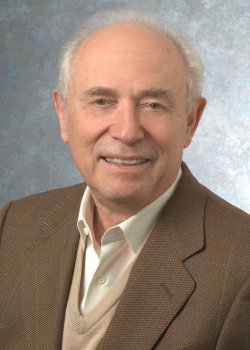
ROBERT SIMHA


Professor Emeritus
Ph.D., Physics and Physical Chemistry, University of Vienna, 1935
Dr. rer. nat. hon.c. Technical University, Dresden, 1987

Room 540
Phone: (216) 368-6372
Fax: (216) 368-4202
Email: robert.simha@case.edu


Research Interests

Hydrodynamics of colloidal suspensions; viscosity and thermodynamics of polymer solutions; chemical kinetics and statistics of synthetic and biological macromolecules; statistical thermodynamics and the thermal and pressure properties of polymer melt, glass crystal, and nanocomposites; phase equilibria in polymer mixtures; the glassy state: steady state and relaxational properties; positron annihilation spectroscopy.

Overview of Research

The general characteristic has been the search for theoretical quantitative rationalization, prediction and its test, and pertinent experimentation. The first endeavor was the extension of Einstein's viscosity theory in two directions. First to moderate concentrations by the introduction of hydrodynamic interactions, second to non-spherical particles. A further modification, particularly suitable to highly concentrated suspensions followed later. It should be noted that the concentration problem has continued to receive attention in the literature up to the present day. The second aspect has been successful in analyses of rod-like suspensions and of protein solutions. Continuing with viscosities of flexible polymers in solution, extensive measurements in good and poor solvents over a range of molar masses served to establish corresponding states representations valid over wide concentration ranges. This served to arrive at empirical representations of the combined effects of hydrodynamic interactions and conformational changes, and to relate viscosity to solution thermodynamics. An early theory of adsorption of flexible chain molecules on solid surfaces represents another example of a combination of chain statistics and thermodynamics. In the area of chemical kinetics and statistics, degradation processes have been a central subject. First there was a statistics of random scission, followed by a most general kinetic formulation of a step process, pertinent for hydrolytic reactions of synthetic and biological macromolecules. Next came a kinetics of depolymerization as a chain reaction. The predictions of this theory have been extensively examined, primarily in pyrolysis. The essential is the competition between a depropagation or unzipping and an inter and intramolecular chain transfer step. This accounts for the wide spectrum in respect to overall rate, molar mass changes and monomer yields, depending on polymer structure. Turning to biological macromolecules, a series of studies deals with sequence analysis and neighbor effects in polynucleotides and proteins, template conditioned replication, and the kinetics of cooperative transformations. The corresponding equilibrium had been treated as a Ising problem. The kinetic solutions now obtained lead in the limit to the classical results, but are obtained by different methods. An extensive range of experimental and theoretical research is concerned with the physical properties of the bulk polymer, primarily, melt and glass. This has involved thermal expansivities in a study of subglass relaxations down to liquid He temperatures. Moreover the pressure-volume-temperature relations were accurately measured. Parallel theoretical studies treat the low temperature glass and extensively the polymer melt. The statistical thermodynamics of a lattice-hole model showed considerable quantitative success in the prediction of thermal and pressure properties, and resulted in generalizations to mixtures including most recently nanocomposites and related phase equilibria, and to modifications appropriate for the glassy state. An ingredient of the theory is the temperature and pressure dependent hole fraction, a particular free volume quantity. This has led to a theory of thermoelastic properties of the glass. Moreover it has provided a link to other free volume dependent properties, namely melt viscosity and viscoelastic relaxation, and it has been the starting point for a dynamics of volume relaxation. We note finally the relation to free volume quantities, derived by means of positron spectroscopy.

Current Activity
Nanocomposites

with L.A.Utracki, Natl.Res. Council,Canada.
The pressure-volume-temperature relations of a polyamid/exfoliated clay combination with varying compositions was determined. Excellent agreement with the predictions of our lattice-hole theory is observed. The model assumes a gradient of molecular mobility, starting with a layer of attached chains and reaching asymptotically with increasing distance the level of pure polymer. Thus the energetic particle-matrix interactions depend on interparticle distances and hence on composition. The free volume is reduced by about 15% in the composite, indicating as a consequence significant changes in mechanical and in transport properties.

Solubility parameter and statistical thermodynamics

in collaboration with L. A. Utracki.
This quantity, a cohesive energy density (ced), has played in the past a semiempirical role in gauging miscibility in polymer solutions and blends. For a volatile liquid it is obtainable from the heat of vaporization. For a polymer it has been derived from a variety of measurements in a series of solvents or swelling agents. The ced of the solvent exhibiting an extremum in the particular property is then adopted as the value for the polymer solute. Values reported in the literature refer to ambient pressure and a standard temperature of 250C, but with considerable variations depending on method employed. These procedures are to be questioned on two grounds. First, a temperature of 250C implies different conditions for different systems, being above or below Tg or Tm. Second, the environment and hence the intermolecular interactions in the melt and solution states differ. We compute the solubility parameter directly by means of our lattice-hole theory. At 250C the values are considerably higher than the tabulated values. Choosing alternatively an "internal" characteristic temperature of Tg+300 K, good correlations between computed and listed values obtain. This implies that an elevated temperature is required to generate corresponding levels of molecular mobility and packing in solution and in bulk, or more simply in free volume levels.

Positron and thermodynamic free volume

with G. Consolati, Politecnico di Milano and B. Olson.
Positron free volumes are conventionally extracted from measured lifetimes by assuming spherical cavities. In a series of polystyrene fractions of varying molar mass differences between these and free volumes derived from thermal expansion data are observed. We show that these can be reconciled by allowing for molar mass dependent anisotropies (disks or prisms) of the cavities.

Gas solubility in polymers

with C. B. Park, University of Toronto.
Detailed experimental data of CD2 in polystyrene and polycarbonate are analyzed in terms of our theory.

Recent Publications

"Statistical Thermodynamics Predictions of the Solubility Parameter," with L. A.Utracki, Polymer International, 53, 279 (2004).

“The Two Critical Concentrations in Polymer Science,” with R. Koningsveld, H. Berghmans, and W. H. Stockmayer, J. Phys. Chem., to be published (2004).

“The Two Critical Concentrations in Polymer Science,” R. Koningsveld, H. Berghmans, R. Simha, and W.H. Stockmayer, Journal of Physical Chemistry B, 108(41), 16168-16173, October 14, 2004.

“Pressure-volume-temperature Dependence of Polypropylene/Organoclay Nanocomposites,” L.A. Utracki and R. Simha, Macromolecules, 37(26), 10123-10133, December 28, 2004.

Awards

Inaugural Raymond F. Boyer Distinguished Lecturer, Case Western Reserve University, 2000
Polymer Physics Prize, Am. Phys. Soc
A. Cressy Morrison Prize, N.Y. Acad. Sci.
Bingham Medal, Society of Rheology
Distinguished Service Award, Washington Academy of Sciences
Meritorious Service Award, U.S. Dept. of Commerce
Superior Accomplishment Awards, Natl. Bureau of Standards
Certificate of Recognition, NASA.

Visiting Professorships: Dresden, Eindhoven, Freiburg, Toulouse

Fellowships: Columbia University, Lalor Foundation, J.F. Kennedy Memorial Foundation, British Science Research Council

Fellow: AAAS; Am. Inst. Chem.; Am. Phys. Soc.; N.Y. Acad. Sci. Washington Acad. Sci. Ed. Board, J. Polymer Sci.