|
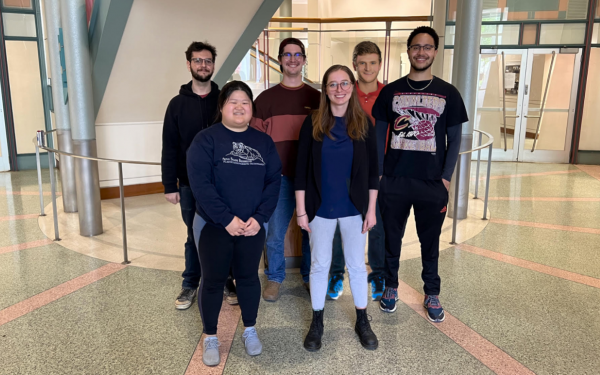
Polymers, which form the basis of plastics, rubbers, coatings, films, fibers, and many other useful things, impact daily life in the most dramatic ways. As a result the polymer industry continues to play a particularly important role in the US economy and in particular Northeast Ohio. Yet, today’s youth know surprising little about this important class of materials. Faculty of the Case Department of Macromolecular Science and Engineering therefore teamed up with the Cleveland Museum of Natural History’s Educational Department to create a pioneering outreach initiative for young high-school scientists from grades 9 through 12. This activity forms part of the “Future Scientists” (FS) program, which is an educational activity run by the Museum’s Robert Segedi (Coordinator of Future Scientists and Adult Programs) and Alison Ball (Youth Programs Coordinator). The FS program addresses high school students and provides learning experiences that are not available in traditional high school coursework. The FS group – typically a “class” of around 10 to 15 students participates year-round in a variety of activities that range from archaeology to ornithology. Four years ago, Case Professors Christoph Weder and Stuart J. Rowan developed the “Polymer Science Days,” which have become a regular component of the FS program. Each year, the FS students are given the opportunity to spend a day in the Macro. Department at Case, where the research groups of Profs. Weder and Rowan offer them a tailored combination of mini-lectures, demonstrations, and hands-on experiments. The “Polymer Science Days” are designed to be fun, provide an introduction to polymers and demonstrate how the latter impact our” daily life. In order to showcase the potential of polymers as advanced materials and highly tailored specialty products, the Macro team has started to highlight current cutting-edge research areas in the “Polymer Science Days.” In a previous program, the topic “Polymers in Electronics” was featured and highlighted the application of polymer semiconductors in applications such as transistors, solar cells and other devices. The future scientists participated in a rather sophisticated hands-on lab program in which polymer light-emitting diodes were fabricated. Demonstrating the interdisciplinary nature of advanced materials research, the activity ranged from the synthesis of a light-emitting polymer, to the patterning of conducting substrates, to the deposition of the polymer by spincoating and the deposition of metal electrodes, to – finally – the testing of the devices built. |